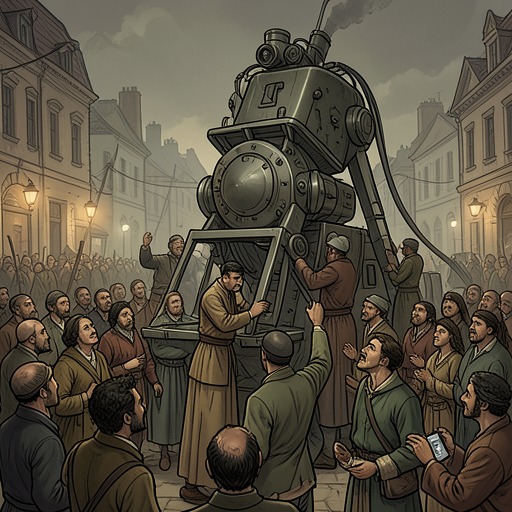
the Discoverer
Last and First MenThe Discoverer is the figure around whom the First World State’s most consequential scientific secret and competing religious traditions converge: he is said to have unlocked subatomic energy, yet his attempt to put its destructive and constructive power into human hands ends in its rejection by the scientists who might have used it. The book presents him partly through a meeting and partly through later legends, leaving a deliberate distinction between what is shown and what subsequent generations believe about him.
Identity and religious traditions
A century after the founding of the First World State, rumors in China described the supreme secret of scientific religion: a way to use the energy held in the opposition of proton and electron. The secret was attributed to a Chinese physicist and saint, identified with the young Discoverer. In the account preserved by the new sect of Energists, he was an incarnation of Buddha. Because the world was supposedly not ready for the revelation, he had entrusted it to the scientists rather than publish it.
The Regenerate Christian Brotherhood, then the most powerful of the Western Churches, recast the same figure as the Son of God returning to bring about a millennium through the disclosure of divine power. In this version, humanity’s failure to live by the earlier gospel of love persuaded him that people could not yet use the new knowledge; he suffered martyrdom for their sake and entrusted the secret to the scientists. These are rival religious interpretations of a shared figure, not independent confirmation of the supernatural claims.
The demonstration and its rejection
At the scientific meeting, the President announces that subatomic energy has been harnessed and that a demonstration is about to be given. The young scientist produces a rifle-like instrument and explains its capabilities: it can initiate the annihilation of matter at a distance and in a chosen direction, and can also inhibit the process. He presents it as both a perfect means of destruction and a potentially unlimited source of power for human industry. He expects organized intelligence to use the weapon to stop war and to distribute industrial energy where it is needed.
The meeting does not accept that promise as sufficient assurance. After arguments for and against the device, the scientists vote unanimously to order the instrument and every account of its construction destroyed. The Discoverer agrees to abide by the decision, but describes the destruction of ten years’ work as a profound personal loss and says he had expected human gratitude. His confidence that science might end internecine conflict is thus answered not by adoption of the weapon but by a judgment that its power is too dangerous to preserve.
The decision unfolds as an American air fleet approaches. The Discoverer studies the western sky through a field-glass and identifies the aircraft as American; another scientist urges him to use the instrument against them. The scene sets his proposed weapon against the immediate prospect of war, but does not establish that he uses it. The meeting’s order to destroy the device and all records remains the stated outcome.
Secrecy and scientific authority
The later legend that the secret was entrusted to scientists has an institutional counterpart. The International College of Science is a closed corporation: entry requires examinations and high fees, membership confers the title of Scientist and the right to experiment, and certain technical secrets are protected by pledges of silence. The account reports rumors that a member who disclosed one such secret died mysteriously. This system makes the scientists plausible custodians of hidden knowledge, while also placing experimental power behind professional barriers and unequal access.
The union of science and religion gives that custody public authority. A religious conference, claiming that some scientists possess the supreme secret, calls for the two organizations to merge. It establishes the Sacred Order of Scientists, whose members are drawn from the International College, supported at public expense, and charged with scientific service and the study of how best to worship Gordelpus, the god of motion. The Discoverer’s reported inheritance thus becomes more than a technical secret: it helps sanctify a scientific elite and makes the fusion of religious leadership with specialized knowledge a governing force.
The contrast between the Discoverer’s demonstration and the later order is sharp. At the meeting, the instrument’s power is visible, tangible, and judged too perilous to retain. In later public belief, the secret survives as an object of reverence, while science itself hardens into dogma and its authority rests on claims that most people cannot examine. The narrative does not resolve how much of the secret actually survives the destruction order; it shows instead how the belief in its custody shapes institutions and faith.
Afterlife in historical memory
The Discoverer’s scientific and religious legacy persists even as the First Men’s civilization collapses. During the later First Dark Age, people use the Swastika or cross as a sacred emblem. In the rebels’ original interpretation, it depicts an aeroplane diving to destruction and signifies the downfall of Gordelpus and the State. Later generations reinterpret it as the mark of a divine ancestor and a memorial to a lost golden age. Its changing meaning reflects the same historical instability surrounding the Discoverer: a figure tied to scientific power and political order becomes part of religious memory, while the circumstances and knowledge of the old civilization are progressively distorted.
The book’s later account of archaeological recovery underscores the gap between inherited legend and historical evidence. Patagonian archaeologists uncover durable metal printing plates in China, and their decipherment exposes the scale and eventual ruin of the earlier civilization. Much later, engineers in Siberia find the Second Men’s stone library, which offers its readers a vivid historical record of the First Men. These recoveries frame the Discoverer’s traditions as part of a past that later peoples must reconstruct from damaged records and transformed beliefs; they do not supply a separate, definitive account of his fate.